Tuesday, 4 March 2008

Sunday, 2 March 2008
More?
Sadly I had to move out of my current flat as the rent were raised exorbitantly from $86 to $103 per week. The landlord's reason for the raise was that he wanted to keep the price in par with that of the area, which is central city, but I wouldn't hesitate to say that he needed the money to finance his renovation of another flat, the backyard and the carpark. Nevertheless, we were saved by the university flat (and the conspicuous lack of interest on those uni flat from 4th year medical student who would have gotten preference over us), their cheap rent ($90) and proximity to the hospital. So, today and yesterday, I was busy moving and the move wasn't easy as raining and coryza* both combined to make a simple house move just slightly tougher. I'm writing this entry while taking a break from the flat cleaning and just to share some more of Gary Larson's genious work.
* Coryza: A cold in the head. The word "coryza" came from the Greek "koryza" which is thought to have been compounded from "kara", head + "zeein", to boil. The "boiling over from the head" refers to the runny nose, an all-too-familiar feature of a head cold.


* Coryza: A cold in the head. The word "coryza" came from the Greek "koryza" which is thought to have been compounded from "kara", head + "zeein", to boil. The "boiling over from the head" refers to the runny nose, an all-too-familiar feature of a head cold.
Thursday, 28 February 2008
Anthropologists! anthropologists!


Gary Larson's cartoons are hilarious and after years of enjoying them, I only found out who drew the comic strip. I've read his collection book when I was 15 and there are more hilarious ones than those shown here. I just couldn't find it on the net (It's copyrighted anyway). His comics are called "the far side".
Wednesday, 27 February 2008
End of thermal adventure

After our epic tour of White Island, we quickly sped off to Taupo and spent the night there. The next morning we head off to Wellington and on the way we stopped by at Wanganui for lunch. We took a route that was luckily just reopened after a recent landslide (the photo below is from one of the lookout stops on this route. Would have been unfortunate to miss out on such a view). Nothing much happens during our journey back. So after 12 days, 4000km and almost $1000 spent, the travel finish. What did I get from this adventure? I have no idea really. The thing that really matters - making yourself closer to your Creator - is not something that I had achieved during this trip. Despite this, I'm an avid traveler and has so long to travel and finally got someone to travel with me. The trip didn't dissapoint a bit (apart from Huka Prawn Park) and I thouroughly enjoyed it.

Saturday, 23 February 2008
Whakatane & White Island


I don't really remember how far exactly is Whakatane from Rotorua but it was close to 2-hour drive north. Read more about Whakatane here if you want. The top photo is some panoramic view of (1) Whakatane and (2) Whakatane beach. We only went there so that we could go to White Island, one of the 3 active volcanoes in NZ. Last year, Lonely Planet rated White Island as a must-see attraction for those in NZ, so we decided to have a peek. There were couple of tours going there. The cheapest is the White Island Tours at NZD160. It involve a boat ride to White Island, which is 46km offshore from Whakatane, and a guided tour of the White Island itself. Morning tea and lunch are provided (they were halal as they were vegetarian meals). Alternatives were tours involving helicopter ride but the cheapest were around NZD300. I recommend the boat ride as while I was on the boat ride I got to see whales doing their breathing thing! Anyway, I imagined the crater of White Island filled with molten lava but instead it is filled with hot steaming coloured water (bottom photo). I was a bit dissapointed, only a bit, as the island is still intriguing. I forgot why it was called White Island but it certainly isn;t white. It mostly consisted of grey rocks that are sometime interrupted by coloured rocks, mud pools, and fumaroles. The coloured rocks are from residual minerals that flow out of the belly of the volcano. Amazingly there were lots of seagulls there (and lots of bridshit too - perhaps that is why some has called it white! :D) The island has a fascinating history itself. In the past, people has thought that it had abundant of top quality sulphur and so some has mined it. It turn out that the sulphur there were of poor grade and the living condition were too harsh. Factory equipments rusted too quickly and frequent earthquakes and landslides has taken many lives. Eventually the mining companies become liquidated and the lawyer who processed the liquidation brought the island off the company and his family remain the owner of the island to this day. Today, White Island is used as a tourist attraction and scientific studies.

Saturday, 16 February 2008
Rotorua Part 3

Rotorua is only 1.5 hrs drive up north from Taupo and is part of the volcanic band that ran across North Island from Taupo to Whakatane. 2 things I noticed once I arrived there: (1) the air had the stench of rotten eggs and (2) there were considerable presence of Maori culture compared to other towns I’ve been before. (1) is because there were plenty of sulphur at Rotorua and (2) Rotorua is a cultural tourist centre of NZ. If one would like to see Maori culture but have limited time, this is the place to go. One can see and experience kapahaka (Maori dance), powhiri (greeting ritual) and tangi (feast) at the Maori village located just on the outskirt of Rotorua. I didn’t go there because I had enough of Maori culture after 4 years here in NZ. :D Anyway, we stayed at the Funky Voyager backpacker, a Rotorua backpacker accommodation which had the highest BBP rating. The facilities were good and the managers were really friendly too. We went to:
(1) Rainbow Springs & Kiwi Encounters: a nature park displaying what NZ jungle has to offer. Also, this is where we got to see the Kiwi bird, an almost extinct bird that NZ has adopted as one of it national icon.
(2) Wai-O-Tapu: Has hot water pool, geyser (we missed this as we arrive 1 hour late from its usual time of eruption – 10am), terraces (silica rocks in a river-like formation – this can form rice paddy-like formation and creates ladder water pools), mineral pool (coloured water pool), fumaroles and mud pools. (second bottom photo)
(3) Waimangu Volcanic Valley: Arrived beyond 6 pm so was not allowed to enter but from the outside looked really lovely. This is the site of a volcanic eruption that destroyed surrounding villages during the 1800s. (top photo: top-left is one of the farm surrounding the valley)
(4) Burried Village: A preserved excavation site of one of the village that was destroyed by a volcanic eruption during the 1800s (top photo: bottom-left)
(5) Blue Lake, Green Lake and Lake Tarawera: top photo: top-right
(6) Redwoods: A park where Californian Redwoods were planted. These were massive tree (height up to 30 meters and diameter of main trunk up to 1.6m). In NZ, these trees grew much faster than those in their native land. (top photo: bottom-right is the fern bush located on the outskirt of this park) (first bottom photo: me standing underneath an average size Redwood).
Next stop is Whakatane.
(1) Rainbow Springs & Kiwi Encounters: a nature park displaying what NZ jungle has to offer. Also, this is where we got to see the Kiwi bird, an almost extinct bird that NZ has adopted as one of it national icon.
(2) Wai-O-Tapu: Has hot water pool, geyser (we missed this as we arrive 1 hour late from its usual time of eruption – 10am), terraces (silica rocks in a river-like formation – this can form rice paddy-like formation and creates ladder water pools), mineral pool (coloured water pool), fumaroles and mud pools. (second bottom photo)
(3) Waimangu Volcanic Valley: Arrived beyond 6 pm so was not allowed to enter but from the outside looked really lovely. This is the site of a volcanic eruption that destroyed surrounding villages during the 1800s. (top photo: top-left is one of the farm surrounding the valley)
(4) Burried Village: A preserved excavation site of one of the village that was destroyed by a volcanic eruption during the 1800s (top photo: bottom-left)
(5) Blue Lake, Green Lake and Lake Tarawera: top photo: top-right
(6) Redwoods: A park where Californian Redwoods were planted. These were massive tree (height up to 30 meters and diameter of main trunk up to 1.6m). In NZ, these trees grew much faster than those in their native land. (top photo: bottom-right is the fern bush located on the outskirt of this park) (first bottom photo: me standing underneath an average size Redwood).
Next stop is Whakatane.


Thursday, 14 February 2008
Hauora Maori

Taking a break from my ramblings on my North Island Trip to write something about the 3 day course on Maori Health I just participated a few days ago. It’s like killing two birds with one stone as one might put it, as I could do revision as well as sharing this knowledge with the few readers of my blog here. The photo above is the marae (local hall for Maori) where I stayed for the course.
The course on Maori Health is part of my medical training. It aimed to train physicians that could practise in a culturally safe and competent manner. Such course was developed mainly due to (1) the health disparity that exist between Maori and non-Maori (ie NZ European) and (2) the NZ government obligation to honour the Treaty of Waitangi. The health disparity is such that Maori life expectancy is 10 year less of that of non-Maori. Some have associated this to lower socioeconomic status but statistics showed that when adjusting for socioeconomic status, the disparity remains. Others have associated it with the “warrior” gene or “diabetic/heart attack/etc” genes to explain the disparity. For them, Maori are just inherently vulnerable to diseases that plagued modern society. However, such thinking is non-constructive and only serves to push the disparity further. Another explanation is that the health system itself is constructed in a way that “institutional racism” was practised. This is not to say that the practitioners are bunch of racists, far from that, but the system itself is formed to cater for one particular ethnic group and thus leaving another deprived. Even if the practitioners were compassionate indiscriminately but the system they are working in does not favour the patient, it will remain a stumbling block for the patient to accept such practise and thus refuse to use it. Hence, Maori has the tendency to use less of health services compared to non-Maori. This often leads to late presentation and higher mortality. With this fault in mind, the whole health system needed a revamp and thus a few steps were taken. For instance, Maori health workers were introduced and their role was to advise practitioners on how to effectively deal with Maori patients. Maoris were also appointed to as members of District Health Board, the regional governing body of the health services in NZ, in order to ensure practices do not leave out Maoris. Furthermore, practitioners were also trained to be culturally safe and culturally competent in order to effectively engage with patients. Thus a course on Maori Health or “Hauora Maori” (Hauora = health in Te Reo, the Maori language) was developed. One aspect of the teaching is the introduction of the Maori Health model known as Te Whare Tapa Wha = the four cornerstone (Whare = building, wha = four). It basically means that Maori health is not only focused on the tinana (physical) aspect but also on hinengaro (mental), spiritual (wairua) and whanau (family) aspects. In order to engage Maori patient effectively, these four aspects must be taken into consideration in diagnosis process as well as the management. In addition, the approach to a Maori patient is different to non-Maori. One can develop better rapport if one engages in whakawhanaungatanga (building connection). This involves sharing your origin to the patient before proceeding to kaupapa (reason/cause of consultation, literally = reason). A practitioner should also be aware of Maori beliefs, values and experiences (MBVE) and how to handle these. One example of MBVE is the use of Te Reo and research has shown that acknowledging Maori patients use of Te Reo result in a more satisfactory consultation. One of the classes in that course that I just did thought us some Te Reo. Here are what I learnt:
The course on Maori Health is part of my medical training. It aimed to train physicians that could practise in a culturally safe and competent manner. Such course was developed mainly due to (1) the health disparity that exist between Maori and non-Maori (ie NZ European) and (2) the NZ government obligation to honour the Treaty of Waitangi. The health disparity is such that Maori life expectancy is 10 year less of that of non-Maori. Some have associated this to lower socioeconomic status but statistics showed that when adjusting for socioeconomic status, the disparity remains. Others have associated it with the “warrior” gene or “diabetic/heart attack/etc” genes to explain the disparity. For them, Maori are just inherently vulnerable to diseases that plagued modern society. However, such thinking is non-constructive and only serves to push the disparity further. Another explanation is that the health system itself is constructed in a way that “institutional racism” was practised. This is not to say that the practitioners are bunch of racists, far from that, but the system itself is formed to cater for one particular ethnic group and thus leaving another deprived. Even if the practitioners were compassionate indiscriminately but the system they are working in does not favour the patient, it will remain a stumbling block for the patient to accept such practise and thus refuse to use it. Hence, Maori has the tendency to use less of health services compared to non-Maori. This often leads to late presentation and higher mortality. With this fault in mind, the whole health system needed a revamp and thus a few steps were taken. For instance, Maori health workers were introduced and their role was to advise practitioners on how to effectively deal with Maori patients. Maoris were also appointed to as members of District Health Board, the regional governing body of the health services in NZ, in order to ensure practices do not leave out Maoris. Furthermore, practitioners were also trained to be culturally safe and culturally competent in order to effectively engage with patients. Thus a course on Maori Health or “Hauora Maori” (Hauora = health in Te Reo, the Maori language) was developed. One aspect of the teaching is the introduction of the Maori Health model known as Te Whare Tapa Wha = the four cornerstone (Whare = building, wha = four). It basically means that Maori health is not only focused on the tinana (physical) aspect but also on hinengaro (mental), spiritual (wairua) and whanau (family) aspects. In order to engage Maori patient effectively, these four aspects must be taken into consideration in diagnosis process as well as the management. In addition, the approach to a Maori patient is different to non-Maori. One can develop better rapport if one engages in whakawhanaungatanga (building connection). This involves sharing your origin to the patient before proceeding to kaupapa (reason/cause of consultation, literally = reason). A practitioner should also be aware of Maori beliefs, values and experiences (MBVE) and how to handle these. One example of MBVE is the use of Te Reo and research has shown that acknowledging Maori patients use of Te Reo result in a more satisfactory consultation. One of the classes in that course that I just did thought us some Te Reo. Here are what I learnt:
Vowels:
E pronounced as better
I pronounced as feet
A pronounced as apple
O pronounced as whore (my tutor used this example)
U pronounced as food
AU pronounced as no
I pronounced as feet
A pronounced as apple
O pronounced as whore (my tutor used this example)
U pronounced as food
AU pronounced as no
Consonants: H, K, M, N, P, R, T, W, NG, WH (pronounced as fart)
The syllables end when a vowel meets a consonant. Here is some Te Reo:
Tena Koe = hello to one person
Tena korua = hello to two people
Tena kotou = hello to more than two people
Kia ora = hello, be well.
Tena Koe = hello to one person
Tena korua = hello to two people
Tena kotou = hello to more than two people
Kia ora = hello, be well.
Wednesday, 13 February 2008
Rotorua part 2

I'm back from Akaroa and am tired. However, I still managed to complete more panoramic photo of my North Island trip and the top one is from Waimangu Volcanic Valley and the bottom one is Lake Tarawera, both of which is several kilometers away from Rotorua. I'm pretty novice at producing panoramic photo and there were several failed ones. I'm not sure if this is true, but it seemed that large body of water, ie lake, is not suitable for such photography technique. Another problem I came across is that item up close can interfere with item up far if the item up close is too close. Then there is the problem of one of the photo component going off at an angle. I think I could overcome this last problem by using a tripod. Before anyone takes advice from this entry, I would like to reiterate that I'm a complete idiot when coming to taking panoramic photo.

Monday, 11 February 2008
Rotorua Part 1

In an hour time, I'm off to Akaroa for a 3 day course on Maori Health. So in the meantime, I present to you a panoramic photo of Lake Rotorua. I misjudged one of the photos and the angle went off horribly and my attempt to get 360 degree panoramic photo of Lake Rotorua failed. The quality of photo was considerably reduced to reduce the size to less than 200kb.
Saturday, 9 February 2008
Taupo part 3

The final edition of this entry and I just want to summarise what I did at Taupo in chronological order as not to confuse anyone:
Night 1: Visited the Tokaanu Thermal Park and walked the hot pool trail that was behind it. Tokaanu is a few kilometers off Turangi, which is a few kilometers south of Taupo on State Highway 1. Later, we drove around Taupo, stopping at several lookout points there (photo of Lake Taupo during dusk at bottom of entry). We stayed both night at Rainbow Lodge Backpackers. I highly recommend that place, it deserved the highest BPP (an organization that organize discounts for backpacking accomodation) ratings they had.
Day 2: Went to Tongariro National Park (photo top-left), Whakapapa, Mt Ruapehu Ski field (photo right-bottom and top), a Maori redoubt (photo bottom-left), and Lake Rotaia. Finished the day with a hot pool bath at Tokaanu Thermal Park
Day 3: Went to Huka falls (photo in previous post), Huka Prawn Park (not worth visiting unless you only plan to dine), Huka falls jet boat ride (good fun), and Craters of the Moon thermal park (photo in previous post). The rest of the day spent traveling to Rotorua.

Friday, 8 February 2008
End of holiday review
Yes, sadly my holiday has ended eventhough it was an uneventful one apart from the epic 12 day adventure i had early on. It was meant to be uneventful as I only planned the following for my holiday:
1. NZ north Island trip - checked. See my ongoing chronicle of thermal adventurer
2. Meet family - checked. I realised I wasn't that close to my extended family, at least not what my parents had expected. I blame the generation gap, my 4 years at UK and away from them during my formative years, and my inept social skill for that.
3. Meet old friends - not really checked. Did meet some old friends but could have put more effort in it. Most of them are working now, some even got hitched, which made me think it wasn't appropriate for me to ask them to hang out a lot. That did get in the way but I could have at least visited them. Again my inept social skill comes to haunt me. Anyway, I would like to thanks those who managed to squeeze some time to hang out - Haarith for the soccer match, Mus & Syakir for the Sg Tua swim, Moezz for the BBQ. There were more but I only met them in weddings, lots of weddings, in fact almost every weekend I attended one. My peers are getting hitched one by one which meant one thing - everyone going to ask "when is yours?"
4. Shopping - checked.
5. Invest - not checked.
6. Self rehabilitation/improvement -broad category but I can safely say not checked. Some of the things I wanted to improve:
i) normal body clock - wake up early, sleep early: Hardly achieved, looked like my body is a night-type.
ii) stop video gaming: Played games when bored during the holiday. There were lots of boring days. I did however uninstall all games in my laptop and so once I arrived in NZ, this would come to realisation. I need it to be.
iii) rejoin usrah/da'wah: Didn't do it. Was too lazy.
iv) relearn swimming: Didn't do it. Day was spent sleeping (see i)
v) gym workout: Didn't do it. as iv
vi) read more: ii and i prevented me from this
vii) learn Arabic: as vi
7. Dental - checked. I went to the government clinic and it cost me rm2 for a checkup and a scaling. There was a one month waiting period though between the checkup and scaling.
8. Kinabalu/travel Malaysia - not cheked. Didn't really plan this at all and was just something that came up while I was getting bored at Malaysia. Due to lack of planning, it never matearilised even though I initially rallied up some people for it.
1. NZ north Island trip - checked. See my ongoing chronicle of thermal adventurer
2. Meet family - checked. I realised I wasn't that close to my extended family, at least not what my parents had expected. I blame the generation gap, my 4 years at UK and away from them during my formative years, and my inept social skill for that.
3. Meet old friends - not really checked. Did meet some old friends but could have put more effort in it. Most of them are working now, some even got hitched, which made me think it wasn't appropriate for me to ask them to hang out a lot. That did get in the way but I could have at least visited them. Again my inept social skill comes to haunt me. Anyway, I would like to thanks those who managed to squeeze some time to hang out - Haarith for the soccer match, Mus & Syakir for the Sg Tua swim, Moezz for the BBQ. There were more but I only met them in weddings, lots of weddings, in fact almost every weekend I attended one. My peers are getting hitched one by one which meant one thing - everyone going to ask "when is yours?"
4. Shopping - checked.
5. Invest - not checked.
6. Self rehabilitation/improvement -broad category but I can safely say not checked. Some of the things I wanted to improve:
i) normal body clock - wake up early, sleep early: Hardly achieved, looked like my body is a night-type.
ii) stop video gaming: Played games when bored during the holiday. There were lots of boring days. I did however uninstall all games in my laptop and so once I arrived in NZ, this would come to realisation. I need it to be.
iii) rejoin usrah/da'wah: Didn't do it. Was too lazy.
iv) relearn swimming: Didn't do it. Day was spent sleeping (see i)
v) gym workout: Didn't do it. as iv
vi) read more: ii and i prevented me from this
vii) learn Arabic: as vi
7. Dental - checked. I went to the government clinic and it cost me rm2 for a checkup and a scaling. There was a one month waiting period though between the checkup and scaling.
8. Kinabalu/travel Malaysia - not cheked. Didn't really plan this at all and was just something that came up while I was getting bored at Malaysia. Due to lack of planning, it never matearilised even though I initially rallied up some people for it.
Monday, 4 February 2008
Taupo part 2
The chronicle blabla title is a bit too long so in keeping with my lazy attitude, I'm sticking with the simpler version from now on. We spent 2 nights here at Taupo though originally planned for one, but there was much to see and do here. For starters, Taupo lake is stunningly beautiful. This blue lake was once a huge volcanic crater belonging to a volcano that is thought erupted 25,000 years ago and gave birth to North Island itself. I think, I might be talking crap here (about giving birth part, the rest I'm sure is true) and couldn't be bothered checking my facts about it. Unfortunately I don't have any personal photo of the lake (there's plenty of that on the net) but here are some photo (top 2) I have taken on the Taupo bungy, which is located at the river flowing from the lake:
 So, no, I didn't do the bungy. Reason: I already did it 2 years ago on a more spectacular paltform. My take on bungy: do it. If anyone come and live in NZ and never does it, they are missing out. Taupo Bungy is one of the cheapest in NZ but bungy is not that cheap. At Taupo it'll cost you NZD 140 for the first jump. Subsequent jump for that day is NZD 40. The one I did, the Nevis at Queenstown - a mere 143m drop and 8 second freefall, compared to this one, just less than 50m - cost me nzd 200. The night prior to the jump, I thought "wtf was I thinking? If it goes wrong, its suicide." and "200 dollars for an 8 second jump that may kill you, are you serious?". I don't know, or bother to go looking for, about the casualty rate of bungy jumping but it should be pretty low because it remains a commercial activity and so what the heck, I did it but not without fear. I looked back at my jump, which was caught and immortalised on DVD, and the look on my face had fear in every inches of it. I rationalise by thinking how safe it would be, but my, when you fall, the speed of your fall is tremendous as the grounds seemed closer and closer in mere seconds, and you don't feel any pull of the rubber that prevents you from going splat. Lucky I didn't wet my pants - the other thing I was afraid of but just to get the facts straight, I never ever did in my life -and the jump went well - hey, I'm still here. Before the jump, the operator told us that the rubber was from Malaysia, he even said "this better be good". It was good, as one would say Malaysia Boleh. Anyway, I was there at Taupo Bungy because my traveling companion did the jump. When asked what he felt, his answer was "confused" due to "mismatching between perception of movement and sense of movement". Weird.
Back to the photo, the bottom-left is from The Craters Of The Moon, a thermal park where there is a self-tour walk through a park filled with numerous fumaroles, craters and some mud pools. The bottom-right is from Huka Falls. Thats taken from one of the lookout point there. One can also go on a speedboat ride in which the boat does 360 spins or just go on a slow cruise. I opted the speedboat ride and it was plenty of fun. That was nzd 99. Now I'm off to Asr.
Sunday, 3 February 2008
Friday, 18 January 2008
Chronicle of Thermal Adventurer: Taupo Part I
Finally, we arrived to Taupo, the start of the "thermal adventure". Don't quote me on this (who does???) but I reckon this is where the volcanic strip that runs across the North Island starts. This volcanic strip features various hot pools, mud pools, geysers, fumaroles, terraces and volcanoes. As with many stunning natural formations in NZ, they become tourist attractions. Fortunately most are cheap/free as most consisted of self-tour. Our first stop was the Tokaanu Thermal Park photographed here in the first three photos from top left going clockwise:


The top left is a boiling mud pool. I heard the mud is good for the skin but I didn't test that theory out. There is a place in between Taupo and Rotorua where one could bath in mud (among others such as hot water pool bath...) for a cool NZD 99 but I didn't bother going because of the price and time. Anyway, Tokaanu Thermal Park charge NZD 8 for a 20 minute hot water bath and then as-long-as-you-like bath in a public swimming pool. That was the cheapest that we ever stumbled on, but also has the most modest facilities. The water is a warm 40 degrees which one need some time to adjust to. And I must admit, 20 minute in a hot water pool is long enough as after 15 minutes I got light headed and needed some time out. Oh, and I did dip my head into the pool and you're not supposed to because one can catch amoebic meningitis that way. Anyway, I only read the warning signs, which was posted on the back of the door to the pool!, after several dips of the head. I'm totally fine by the way, no Kernig sign, no neck stiffness whatsoever after. Continuing with the photo, top-right is the river that flows infront of Tokaanu Thermal Park and bottom-right is one of hot water pool found outside the park. Finally, bottom-left is a photo of the Tongariro River. A river full of rainbow trout thus a popular angling spot. There is even a National Trout Center there where the rainbow trout is farmed.
Monday, 14 January 2008
Cronicle of Thermal Adventurer: Manawatu
So, at the end of the 4th day at Wellington, we headed off to Palmerston North, which is located at the region known as Manawatu. This place was a mere stopping place on our way to Taupo, famed for its beautiful Lake Tuapo and cheap outdoor activity. Taupo (and Rotorua) is the North Island equivalent of Queenstown and Wanaka but more on that later. Anyway, Manawatu has its attraction as well. One of them is the Te Amati Wind Farm, photographed here on top right of the photo:

There are various places to view the wind farm, but the best is the one underneath where the car park is literally beneath one the wind turbine. Wind as a renewable energy source sounds very ideal with its almost non-existent pollution and relatively cheap cost, but practically it is hard to be viable. A place need to have winds that blows frequently enough and strong enough and must also be not too far from its beneficiaries. Anyway, we didn't stay long because we can't. It's too cold, the wind chill is just too much even in spring (1st December is "officially" recognized as start of summer in NZ). The other three photo from bottom right going clockwise: some random valley in the Manawatu region; typical NZ highway - 1 lane with not many cars punctuated by 2 laned "passing lanes" at certain intervals; Mt Ruapehu - one of the 3 active volcanoes in NZ, I heard it just recently erupted some time last year but I am certain that it did erupt in 1997.
There are various places to view the wind farm, but the best is the one underneath where the car park is literally beneath one the wind turbine. Wind as a renewable energy source sounds very ideal with its almost non-existent pollution and relatively cheap cost, but practically it is hard to be viable. A place need to have winds that blows frequently enough and strong enough and must also be not too far from its beneficiaries. Anyway, we didn't stay long because we can't. It's too cold, the wind chill is just too much even in spring (1st December is "officially" recognized as start of summer in NZ). The other three photo from bottom right going clockwise: some random valley in the Manawatu region; typical NZ highway - 1 lane with not many cars punctuated by 2 laned "passing lanes" at certain intervals; Mt Ruapehu - one of the 3 active volcanoes in NZ, I heard it just recently erupted some time last year but I am certain that it did erupt in 1997.
Friday, 11 January 2008
Into the wild
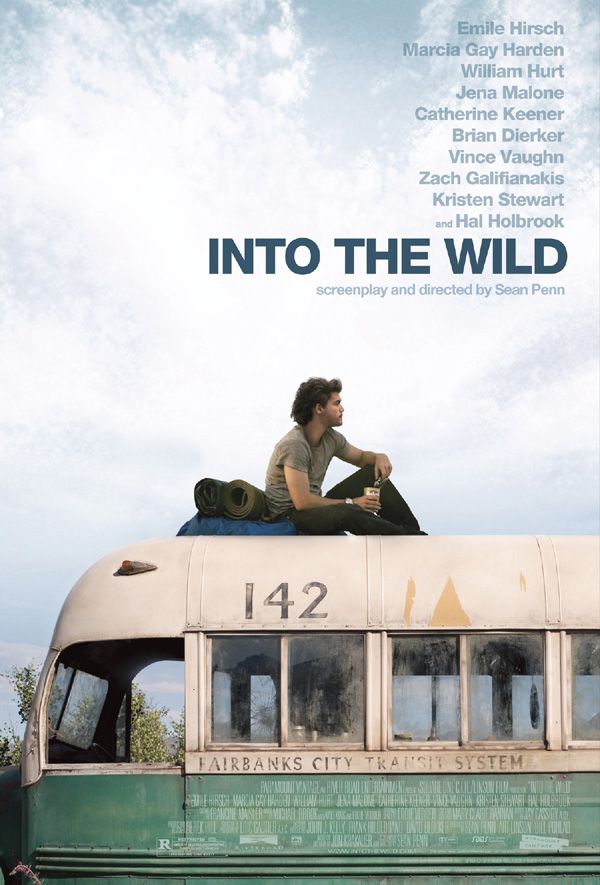
This entry contains spoiler of the movie Into the Wild (2007). A brief synopsis first: Based on true events of Chris McCandless, who after graduating from college at the age of 24, donated all his college funds to charity, left his family and set off to live in the Alaskan wilderness. He hailed from an affluent suburban family, which nevertheless is a disharmonious one and is the reason extrapolated by the moviemaker as why the person hated the society he is in and as to why he had wanted to live self-sufficiently in the Alaskan wilderness. This reason is perhaps accentuated by the influence of the works of Leo Tolstoy, Henry David Thoreau and Jack London, which some say shaped his ascetic personality. The movie portrays his journey, the encounters he met along the way and some explanation of the reasons of his journey. I wouldn't say this movie a classic, but the story of this man did intrigued me somewhat. His ascetic personality is what made me intrigued at a time when I myself are so indulged in my own whims and is searching for a revelation to conquer it. However, it has to be said that his measure was extreme and that pure asceticism is not what is ordained in Islam. To borrow the words of Sayyid Abul A'La Maududi, a great thinker of Islamic revivalism in his book ethical viewpoint of Islam: "this (ascetic) attitude is in radical violation of the entire scheme of nature and is virtual revolt against the Will of God as immanent of His Creation. The greatest harm done to humanity by this wrong concept is that it has removed from practical life some of those individuals whom God had endowed with high moral qualities, thus leaving the field or worldly affairs mostly for the persons of inferior moral calibre." What was ordained in Islam is moderation and what it is that a man to do and don't is clearly written. My problem then is due of something else...
On another note, the idea of secluding oneself either to escape from society that has indulge itself in vices or out of the pursue of internal peace is not new. It was one of the practice of sufism, known as khalwa, and it was based on the fact that Prophet Muhammad (p.b.u.h.) secluded himself from the idolatrous society of pagan Meccans. However, one must remember that this occurred prior to his prophethood and such is not considered a sunnah.
Tuesday, 18 December 2007
Chronicle of Thermal Adventurer: Wellington
And so the journey continues with our 4 days & 4 nights stop at the capital which was named after Arthur Wellesley, Duke of Wellington, the victor of Battle of Waterloo. Here we were graciously hosted by our friends from the medical schools who chose/forced to go here after their third year. Here, our typical day goes like this: morning breakfast with free hot chocolate at med school - sightseeing - lunch - sightseeing - dinner hosted by one of our friend/PSD officer/MSD attache. This part of the trip was more on meeting friends/recruiting people than seeing the city but the city itself is certainly beautiful, much like the rest of NZ, with plenty of attraction to go to. Some photos:


From top left clockwise: NZ parliament with the executive wing affectionately known as "the beehive" on the left; Maori moko (face tattoo) display in NZ art gallery; NZ parliament balloon; Wellington Mosque; Wellington from Mt Victoria Lookout.

Sunday, 9 December 2007
Chronicle of Thermal Adventurer: Chch-Picton
I'm gonna totally ignore my previous post and start this 4-part series chronicling my 12 day adventure at North Island.
 Picton:

 The journey began with a 5 hour bus ride to Picton . We took off from Christchurch at 0700, on an Intercity coach. On the way to Picton, we stopped by at Kaikora, a town famous for its whale-watching cruise and Bleinhem, a town I don't know anything about. The bus ride wasn't particularly spectacular in itself, mostly because I slept the way through - a product of a purposely sleepless night. It's something I would not replicate nor would recommend anyone to do. Catching up on sleeping in a long-haul bus ride in New Zealand is definitely not enjoyable as you will never get enough deep sleep or the REM phase of sleep to refresh your body. I attribute this to one main reason: The seats isn't comfy enough. When compared to Malaysian coaches (those that goes to Malaysian East Coast from KL), the seats are tiny (NZ: 4 seats per row compared to 3 per row for M'sia), and doesn't recline as much (according to my memory) which leaves your head exposed to those embarassing 'bobbing' and 'hanging' positions. Anyway, it was the cheapest (??) way to get to Wellington at that time. The total cost from Christchurch per person was:
Intercity Bus ride Christchurch - Picton: NZD 23.00 (on web saver option - only available when purchasing tickets online using credit card, and on certain days, student price = NZD 41)
Interislander Ferry ride Picton - Wellington: NZD 52.00 (standard price. Web saver option = nzd 45.00 but departs at 1300)
Total = NZD 68.00
Alternative:
Drive yourself: Interislander Ferry ride vehicel x1 = NZD 60.00 + (1 person = NZD 52.00) = NZD 112.00 + estimated feul (NZD 60.00) = 172.00. A cheaper option if you can get at least 4 people going on the same car.
Flights: ~NZD 90.00 (Blenheim/Picton - Wellington). As of 12 November 2007, Fly Pacific Blue will start operating from Chch-Welly and fares could be as low as NZD60 (inc tax).
Kaikora:
 Picton:
Wednesday, 5 December 2007
pointless rambling
I just wanted to write something, just to get my head going. Its been 3 days now, I'm still feeling nauseated from this fever/unknown disease that I'm currently infested with. It's an awful feeling, a feeling that leaves you debilitated to a point of lying helplessly, just waiting for it to pass. I actually planned to write about how I think my state of health is deteriorating but then it got me thinking, what do i get by reading this? (in the future, when I'll look back at my works & get embarrassed by it, lol) But seriously, I have no serious issues to write about, and perhaps it just goes to show how pointless my life is at the moment. I mean look at my previous ramblings, the getting youtube thingy etc., pointless really. At 23, I have yet to achieve anything concrete, any lasting legacy that would one day when I breath my last, I wouldn't regret anything. Maybe some people call it inner peace. Perhaps that is unachievable, or just a state of mind, I really don't know, and confused at the moment. So what do I do?
Oh and the word "thingy" is also another formally recognised colloqial term. Apparently it originated from Australasia for a slang of "thing" but I would not be wrong to say that it is now widely used words. Yet another useless point written here.
Oh and the word "thingy" is also another formally recognised colloqial term. Apparently it originated from Australasia for a slang of "thing" but I would not be wrong to say that it is now widely used words. Yet another useless point written here.
Wednesday, 28 November 2007
pics


Subscribe to:
Posts (Atom)